
In nanoelectromechanical photonics, small mechanical displacements change the geometry that guides and confines light. This allows a photonic circuit’s optical response to be adjusted after fabrication.
Gap-dependent coupling
Consider two waveguides placed alongside each other. Light’s electromagnetic field extends beyond each waveguide’s core, decaying into the surrounding space. When the waveguides are close enough, these evanescent fields overlap, forming a directional coupler that allows optical power to transfer between them.
Changing the gap changes the coupling strength and, for a given wavelength and interaction length, changes how power is distributed between the outputs. An electrostatic actuator makes this geometry electrically adjustable: applying a voltage moves the structure and changes its optical response.
Papon et al., in Optica, demonstrated this principle by using nanomechanical motion to route single photons between waveguides.
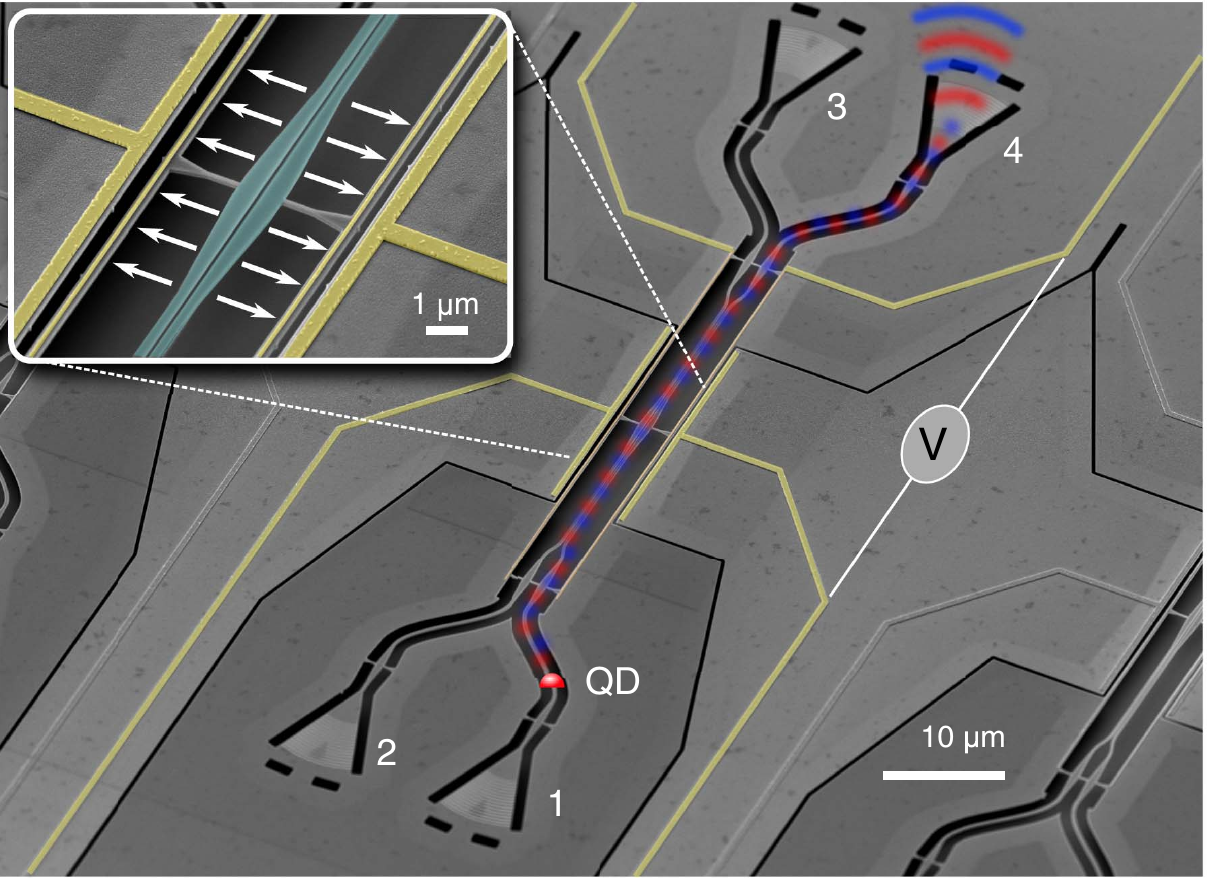
Papon et al.’s nanomechanical single-photon router, with the suspended waveguides magnified in the inset. False-color SEM with an illustrative optical-field overlay. Source: Papon et al., Optica 6, 524–530 (2019), Fig. 1(b).
The possibilities extend beyond routing. Mechanical displacement can also change the phase accumulated by light or shift a cavity’s resonant wavelength, providing several ways to tune and reconfigure photonic circuits.
Static power consumption
A key advantage is the near-zero static power needed to hold a setting. Electrostatic actuators can maintain a position at a fixed voltage with very little steady-state current. Switching and control electronics still consume energy, while optical loss, mechanical response and reliability remain central design considerations.
Lizard Photonics, a DTU - Technical University of Denmark spin-out, is developing NEMS-integrated silicon photonics for energy-efficient optical interconnects in AI data centers, with broader opportunities in programmable photonics and quantum technologies. Its scientific foundations include the founding team’s research at the DTU - Technical University of Denmark on self-assembled photonic cavities with atomic-scale confinement, Nature, 2023, and nanoelectromechanical control of silicon bowtie nanocavities, Nano Letters, 2026.
Integrating NEMS with photonic devices and components offers a way to reduce reliance on continuously powered thermo-optic heaters. This addresses static power consumption and thermal cross-talk, challenges that become increasingly significant as optical engines integrate more densely packed optical channels.
Multiphysics simulation
Designing these devices requires connecting electrical, mechanical and optical behavior. Electrostatic and mechanical models predict displacement, while electromagnetic solvers, including FDTD and FEM, predict the resulting changes in coupling, phase, resonance, and loss. Faster simulations, validated against measurements, could help designers explore more configurations and fabrication tolerances before making a chip.